Presence and Enjoying Life
Summer brings vacations, sunshine, family gatherings, time outdoors, and making memories. Social media feeds are full of smiling faces, adventures, celebrations, and highlight reels; yet daily expectations and priorities still exist.
Sometimes we are so busy documenting experiences that we forget to actually experience them. Sometimes we’re carrying stress from work, family responsibilities, health concerns, or everyday life that follows us no matter what season it is. And sometimes the pressure to enjoy ourselves can actually make it harder to do so.
Many of us spend so much time thinking about what’s next, what needs fixing, what could go wrong, or what we should be doing differently that we miss the moments happening right in front of us.
Take a moment to explore what it means to slow down enough to notice your life as you’re living it - not as you wish it was, not as others’ lives appear online, but as they are.
Our hope is that you give yourself permission to stop chasing the perfect experience and start noticing the meaningful moments that are already here. That you learn to appreciate joy without demanding it. That you become more present with yourself, your loved ones, and your life - not because everything is perfect, but because life is happening now.
Because presence isn’t about having a perfect day, it’s about being available for the day you’re actually having. And sometimes the most meaningful moments aren’t the big milestones or picture-perfect memories, but the quiet conversations, the unexpected laughter, the peaceful cup of coffee, or the simple realization that, right here, right now, you are okay!
-
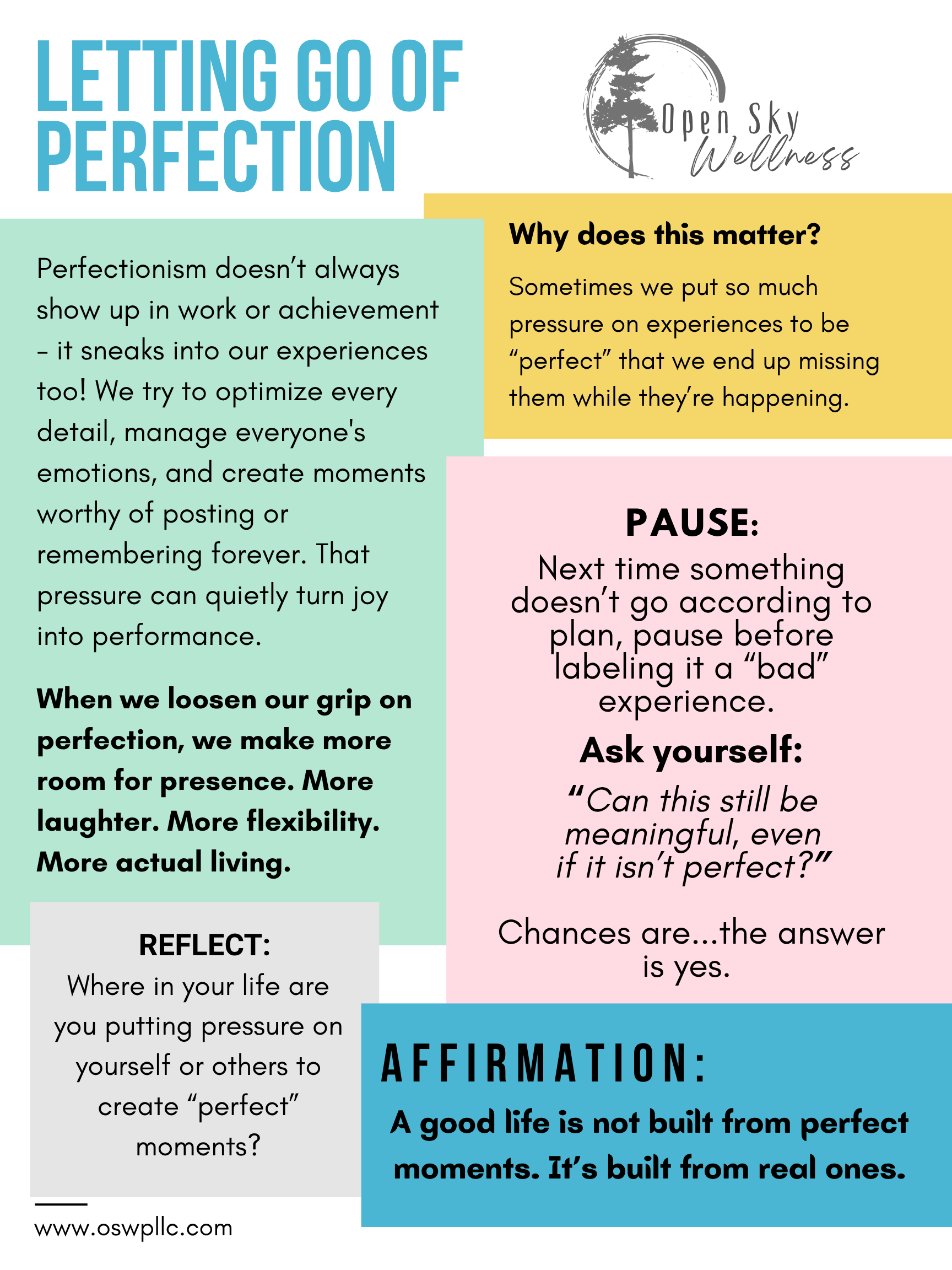
Sometimes we put so much pressure on expereinces to be “perfect” that we accidently miss them while they’re happening. The perfect vacation. The perfect family memory. The perfect holiday, relationship, weekend. workout, photo… you get the idea. Somewhere along the way many of us learned that if something isn’t ideal, it somehow doesn’t count.
But real life is messy. People get tired. Weather changes. Someone gets cranky. The food order is wrong. And somehow, those imperfect moments are often the ones we remember most.
Perfectionism doesn’t only show up in work or achievement - it sneaks into our experiences too. We try to optimize every detail, manage everyone’s emotions, and create moments worthy of posting or remembering forever. That pressure can quietly turn joy into performance.
When we loosen our grip on perfection, we make more room for presence. More laughter. More flexibility. More actual living. The goal isn’t to lower your standards for life - it’s to stop treating every moment like it has to become a core memory under impossible conditions.
Takeaway:
The next time something doesn’t go according to plan, pause before labeling it a “bad” experience.
Ask yourself:
Can this still be meaningful, even if it isn’t perfect?"
Chances are, yes!
A good life isn’t built from perfect moments; it’s built from real ones.
-
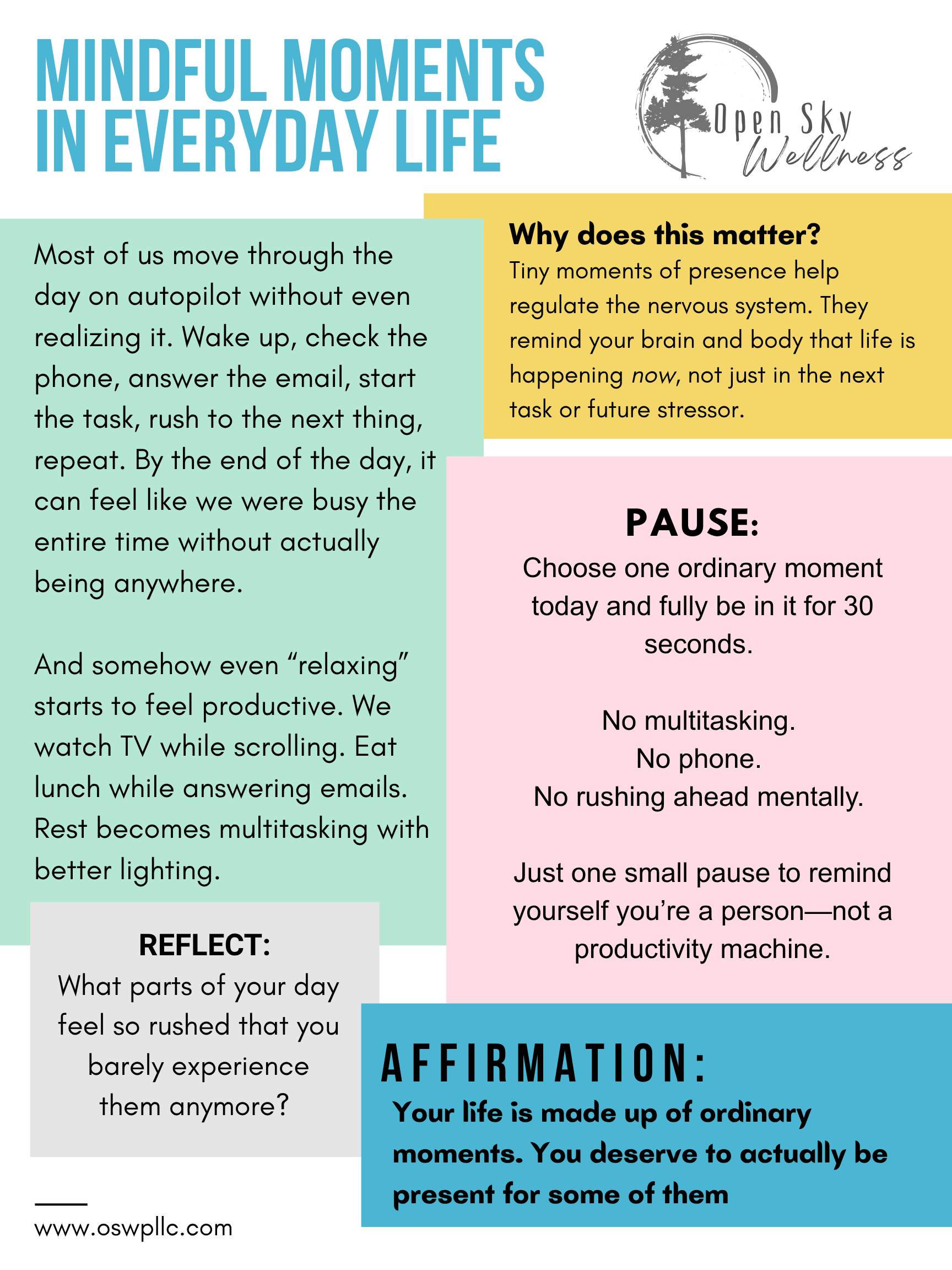
Most of us move through the day on autopilot without even realizing it. Wake up, check the phone, answer the email, start the task, rush to the next thing, repeat. By the end of the day, it can feel like we were busy the entire time without actually being anywhere. Somehow even “relaxing” starts to feel productive. We watch TV while scrolling. Eat lunch while answering emails. Rest becomes multitasking with better lighting.
Mindfulness doesn’t have to mean meditating on a mountaintop or suddenly becoming the kind of person who wakes up at 5 am to journal in silence. Real mindfulness is much smaller - and much more doable.
It’s noticing the warmth of your coffee before the day speeds up. Taking one deep breath before walking into the next meeting. Feeling the sun through the car window instead of mentally rehearsing tomorrow’s to-do list.
Tiny moments of presence help regulate the nervous system. They remind your brain and body that life is happening now, not just in the next task or future stressor.
Takeaway:
Choose one ordinary moment today and fully be in it for 30 seconds
No multitasking.
No phone.
No rushing ahead mentally.
Just one small pause to remind yourself that you’re a person - not a productivity machine.
Your life is made up of ordinary moments. You deserve to actually be present for some of them.
-
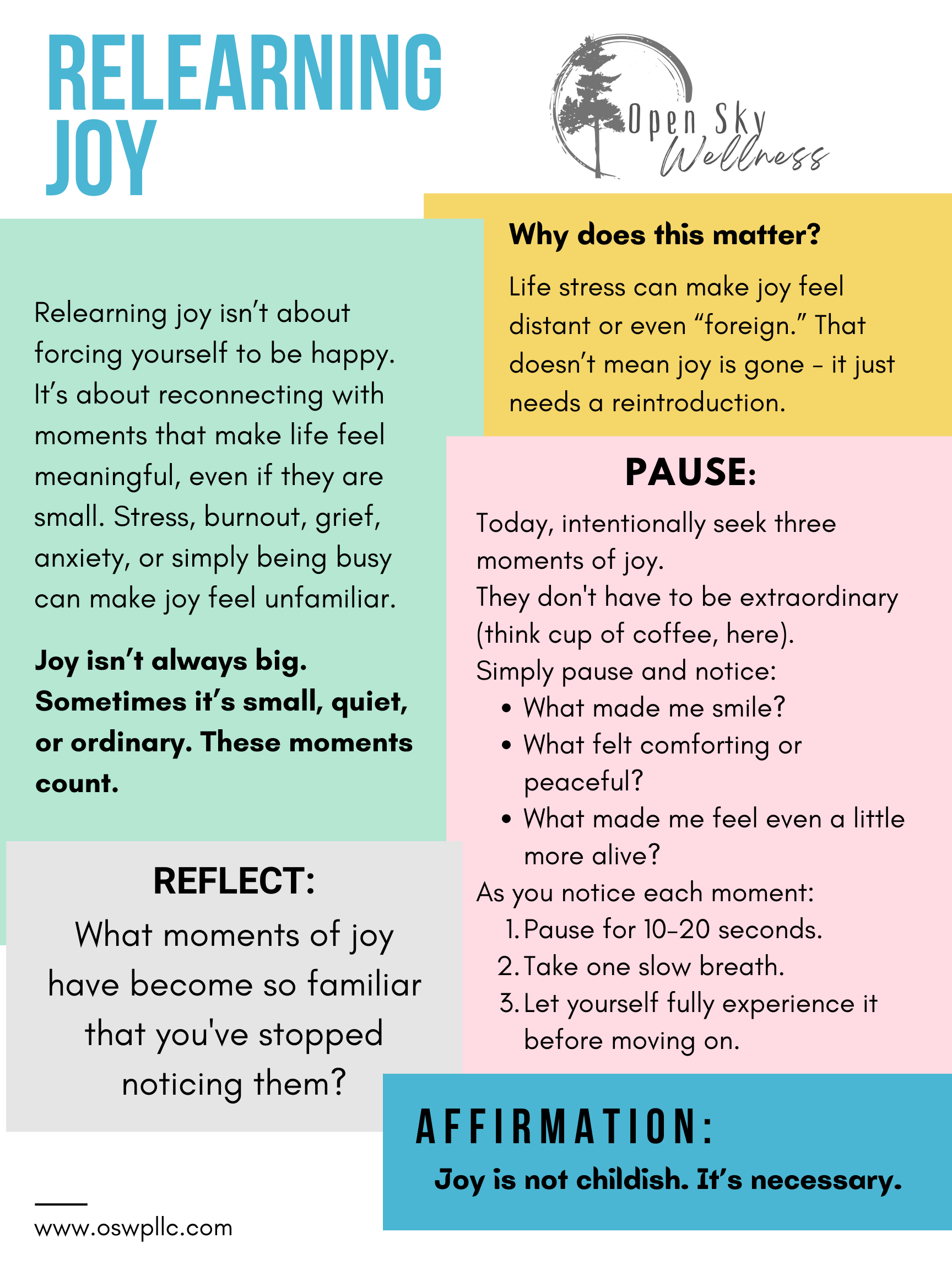
Life has a way of pulling us into survival mode. Between responsibilities, stress, deadlines, caregiving, and endless to-do lists, joy can slowly fade into the background. It may even begin to feel unfamiliar or undeserved.
But joy doesn't disappear - it gets buried beneath everything else.
The good news? Joy doesn’t have to arrive as a life-changing event. More often, it’s found in ordinary moments that we simply haven’t had the space to notice.
We often think joy has to be earned after we’ve finished our work, sovlved our problems, or reached the next milestone. In reality, joy is part of what helps us sustain ourselves through difficult seasons. Joy isn’t always loud or exciting. Sometimes it’s the warmth of your morning coffee. The sound of rain. A song that makes you sing along. Watching your dog greet you like you’ve been gone for years. Laughing with a friend. Feeling the sun on your face. These moments may seem small, but they help regulate the nervous system, increase resilience, and remind us that life is more than surviving.
Takeaway:
Choose one small activity today that brings you joy simply because you enjoy it - not because it is productive, impressive or checks something off of your list.
Joy isn’t childish. It isn’t selfish. It isn’t something you have to earn.
Joy is a protective factor for mental health. It’s one of the ways we refill ourselves so we can continue showing up for the people and responsibilities that matter most.
-
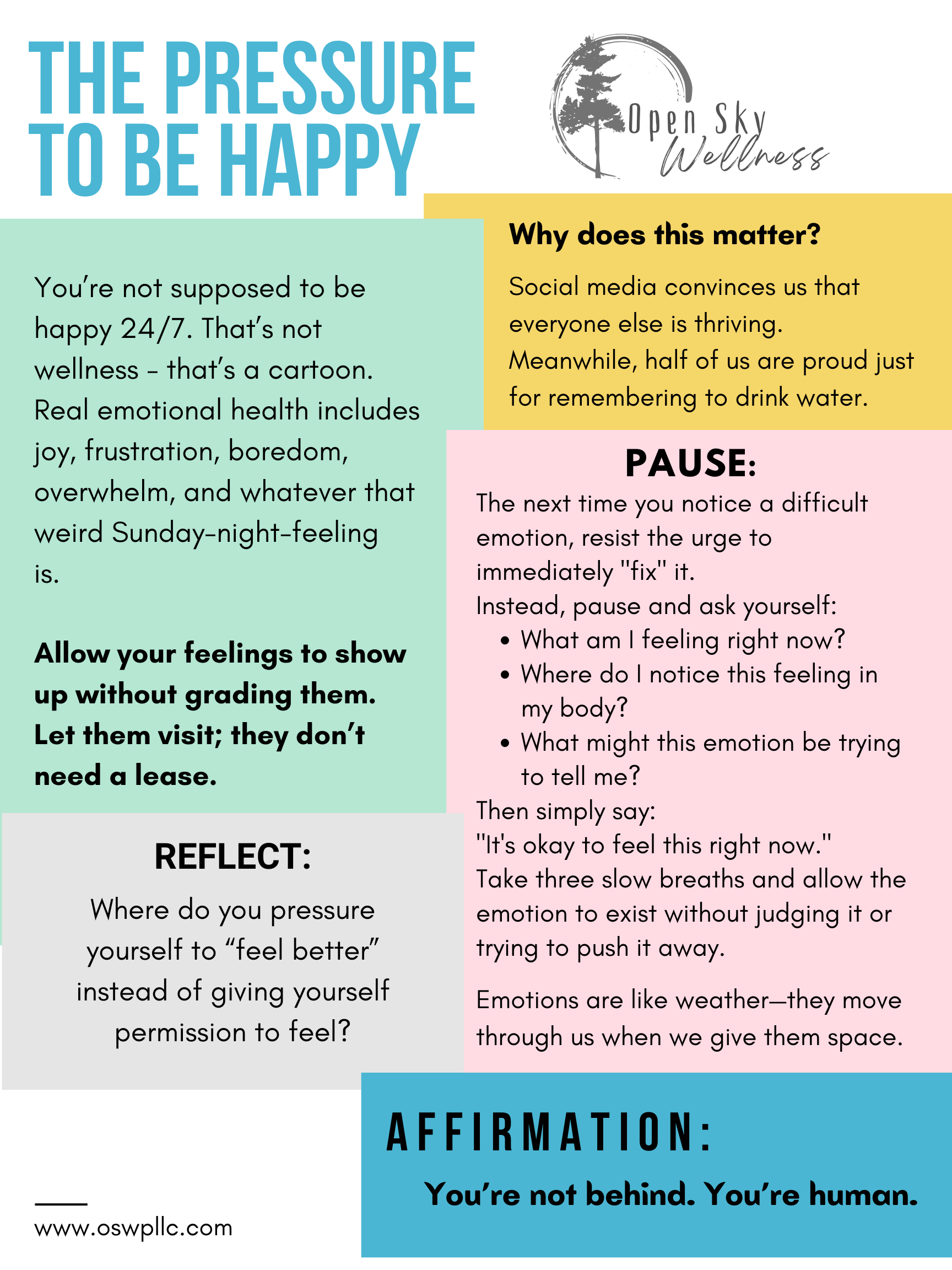
Somewhere along the way, many of us started believing that happiness should be our default setting. We scroll through social media, see vacation photos, promotions, smiling families, and perfectly curated lives, and it’s easy to wonder why everyone else seems to have it figured out.
The truth? Most people are sharing their highlight reel - not the full story.
Real life includes stress, disappointment, uncertainty, grief, joy, excitement, boredom, and everything in between. Emotional wellness isn’t about eliminating uncomfortable emotions - it’s about making room for them without letting them define us.
In fact, trying to avoid difficult emotions often makes them louder. When we stop fighting our feelings and start listening to them, we create space for healing instead of judgment.
Wellness isn’t measured by how often you feel happy. It’s measured by your ability to experience the full range of human emotions with compassion and flexibility. Some days you’ll feel energized, other discouraged. Some days you’ll laugh until your stomach hurts, and others you’ll simply get through. All of these experiences are part of being emotionally healthy. Your emotions aren’t problems to solve - they’re information to understand.
Takeaway:
Practice noticing your emotions today without labeling them as “good” or “bad.”
Instead of asking, “How do I make this feeling go away?”
Try asking, “What does this feeling need from me?”
You don’t have to earn happiness. You don’t have to force positivity. You don’t have to smile through every difficult day. You are allowed to experience the full range of human emotions.
That’s not failure. That’s emotional wellness.